
It's easy to start your application.
Undergraduate Programs
Specialization Areas
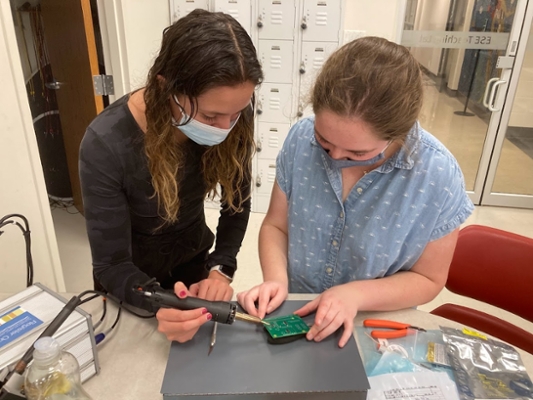
The Department of Electrical & Systems Engineering offers courses across a broad range of topic areas. Specialization areas of study provide students with a critical level of expertise in a particular domain within ESE, preparing the student for a wide range of career opportunities. Furthermore, it allows them to pursue graduate studies in engineering and applied science research.
Suggested example courses within several areas are listed below. To ensure courses fulfill the requirements for your degree or program, consult the Bulletin.
These specializations are not formally recognized – they are meant to illustrate for students what they can do with an ESE degree and help them plan their courses.
Devices and Circuits
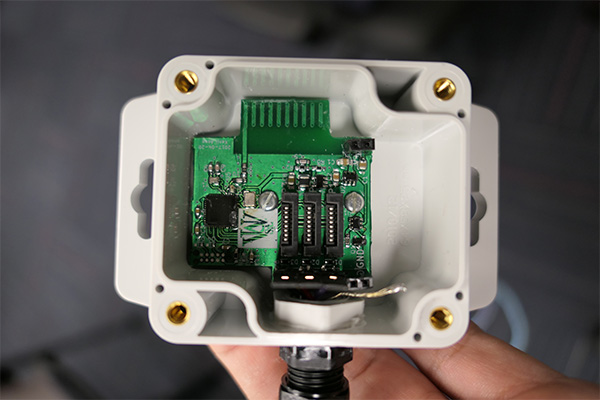
Learn how semiconductor devices, electronic materials, sensors, and analog, digital, mixed-signal, and radio-frequency circuits convert physical and biological phenomena into electrical signals, computation, and communication.
- ESE 4310 Introduction to Quantum Electronics
- ESE 4360 Semiconductor Devices
- ESE 4610 Design Automation for Integrated Circuit Systems
- ESE 5620 Analog Integrated Circuits
- CSE 3602 Computer Architecture (formerly cross-listed as ESE 362)
- CSE 4602 Computer Systems Design (formerly cross-listed as ESE 462)
Apply this knowledge to create energy-efficient computing and AI hardware, flexible and wearable electronics, biomedical instruments, autonomous sensors, radar, and connected devices.
Optics and Photonics
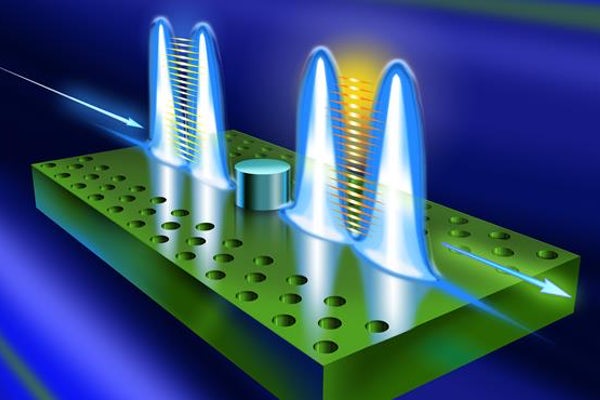
Learn how electromagnetic waves interact with materials and how lenses, lasers, optical systems, microresonators, photonic circuits, metamaterials, and computational methods can generate, manipulate, detect, and interpret light.
- ESE 4290 Basic Principles of Quantum Optics and Quantum Information
- ESE 4380 Applied Optics
- ESE 5310 Nano and Micro Photonics
- ESE 5820 Fundamentals and Applications of Modern Optical Imaging
Apply this knowledge to telecommunications, optical computing, precision sensing and metrology, biomedical and nanoscale imaging, environmental monitoring, and new tools for studying molecules, cells, and materials.
Quantum Engineering
Learn how quantum mechanics, quantum optics, quantum information theory, quantum control, and nanoscale device physics enable engineers to prepare, manipulate, transmit, and measure quantum states of light and matter.
- ESE 4290 Basic Principles of Quantum Optics and Quantum Information
- ESE 4310 Introduction to Quantum Electronics
- ESE 4390 Introduction to Quantum Communications
- ESE 5320 Introduction to Nano-Photonic Devices
- ESE 5360 Introduction to Quantum Optics
Apply these principles to quantum computing and communication, secure information technologies, precision sensing and imaging, and photonic devices that operate beyond the limits of conventional electronics and optics.
Signals & Imaging
Learn how mathematical modeling, probability, estimation, signal and image processing, information theory, and machine learning can recover meaningful information from noisy or incomplete measurements.
- ESE 4170 Machine Learning
- ESE 4710 Communications Theory and Systems
- ESE 4820 Digital Signal Processing
- ESE 4880 Signals and Communication Laboratory
- ESE 5200 Probability and Stochastic Processes
- ESE 5820 Fundamentals and Applications of Modern Optical Imaging
- ESE 5890 Biological Imaging Technology
Apply these tools to medical and scientific imaging, computer vision, radar and remote sensing, wireless communication and localization, and technologies that reveal the structure and function of biological systems.
Robotics and AI
Students taking courses in this specialization area will develop expertise in robotics, control, and autonomy including state-of-the-art AI methods. Applications include driverless cars, UAVs, medical and service robots, and human-robot teams.
Systems Science electives:- ESE 4450 Sensing, Planning, and Control in Robotics
- ESE 4210 Decision and Estimation Theory for Discrete Stochastic Processes
- ESE 4170 Machine Learning
Systems students interested in this area might consider an outside concentration in computer science.
Computational Social Systems
Students taking courses in this specialization area will apply principles of mathematical modeling and optimization to societal problems, including public policy, sustainability, and social choice.
Systems Science electives:
Systems Science electives:
- ESE 3090 Special Topics in Systems Engineering: Modeling and Decision of Social Choice Systems
- ESE 3590 Signals, Data, and Equity
- ESE 4210 Decision and Estimation Theory for Discrete Stochastic Processes
- ESE 4170 Machine Learning
Systems students interested in this area might consider an outside concentration in economics, sociology, or political science.
Financial Engineering
Students taking courses in this specialization area will learn about modeling, analysis, and computation in financial math applications.
Systems Science electives:
Systems Science electives:
- ESE 4261 Statistical Methods for Data Analysis with Applications to Financial Engineering
- ESE 4270 Financial Mathematics
- ESE 4210 Decision and Estimation Theory for Discrete Stochastic Processes
- ESE 4170 Machine Learning
Systems students interested in this area might consider an outside concentration in economics, mathematics, or computer science.
Applied Math
Students taking courses in this specialization area will learn to develop mathematical models of real-world phenomena in areas such as physics and medicine.
Systems Science electives:
Systems Science electives:
- ESE 4150 Optimization
- or ESE 4031 Optimization for Engineered Planning, Decisions, and Operations
- ESE 4170 Machine Learning
- ESE 5510 Linear Dynamic Systems
- and/or ESE 5530 Nonlinear Dynamic Systems
Systems students interested in this area might consider an outside concentration in physics, math, computer science, biomedical engineering, and more.
Suggested Courses outside ESE
Suggested courses from the Physics department are listed below, suitable as Engineering and Science Breadth requirement for Electrical Engineering students and Outside Concentration courses for Systems Science & Engineering students.
- Physics 361: Optics and Wave Physics Laboratory
- Physics 322: Physical Measurement Laboratory
- Physics 350: Physics of the Brain
- Physics 354: Physics of Vision
- Physics 360: Biophysics Laboratory
- Physics 427: Introduction to Computational Physics
- Physics 472: Solid State Physics